

3 September 2026 · Alex Morgan
Pickleball Rules Explained (UK Beginner Edition)
Pickleball rules for UK beginners: serving, the kitchen, scoring, faults and the two-bounce rule, explained simply so you can play your first game.
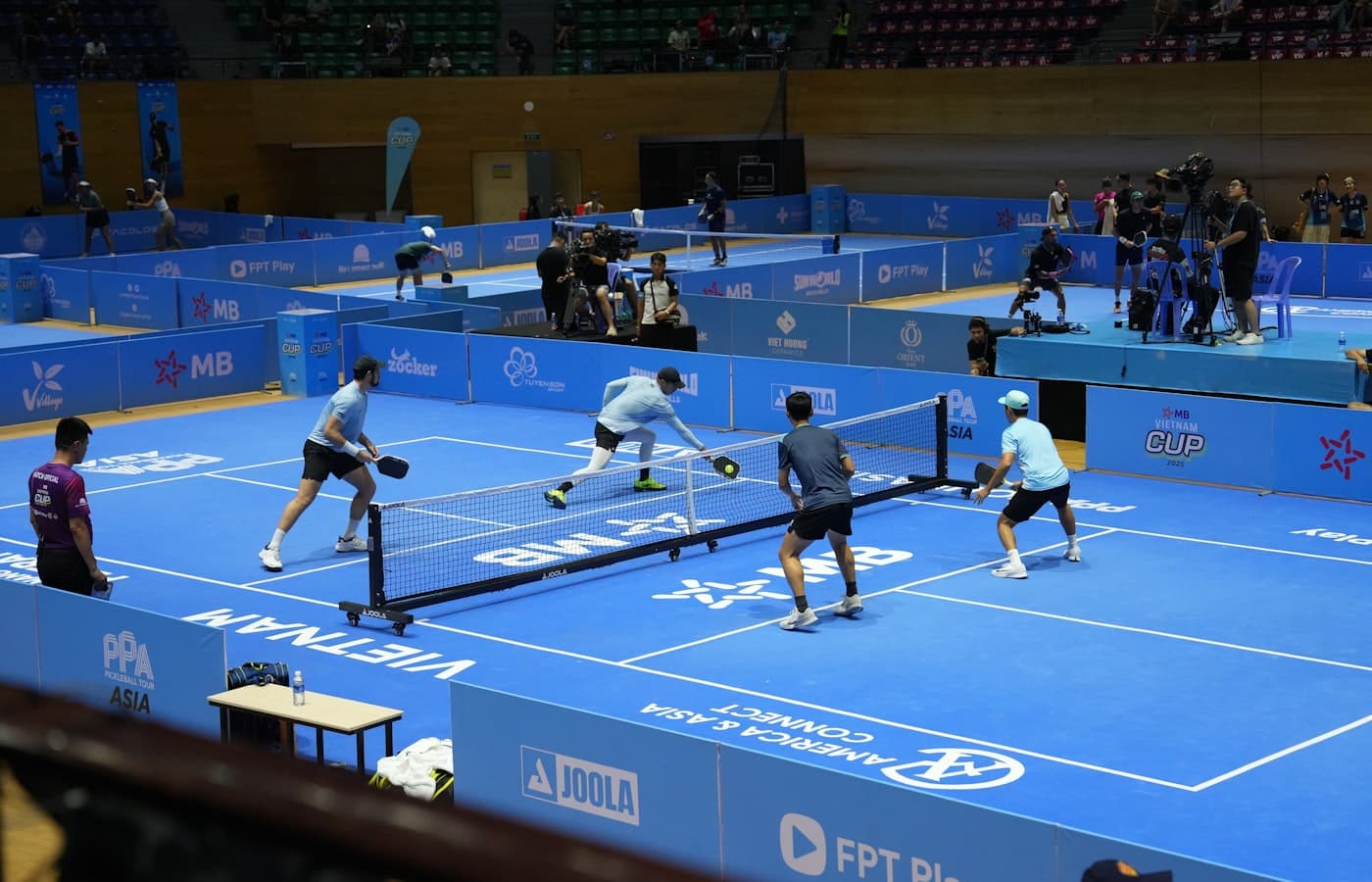
You can learn enough pickleball rules to play in about five minutes. Serve underarm and diagonally, let the serve and the return both bounce before anyone volleys, don't volley while standing in the 7ft zone by the net, and only the serving side scores. Games go to 11, win by two. That's the sport. Everything below fills in the detail, in roughly the order it'll come up in your first few games at a UK club night.
The court and the kit
A pickleball court is 20ft by 44ft. Identical to a badminton doubles court, which is why so many UK sports halls can run pickleball with nothing more than a portable net. The net is 36in at the posts and 34in in the middle, noticeably lower than a badminton net.
Either side of the net is a 7ft zone running the full width of the court. That's the non-volley zone, universally called the kitchen. It's marked by a line, and that line counts as part of the kitchen.
The rest is a solid paddle and a perforated plastic ball. Indoor balls have larger holes and are lighter; outdoor balls are heavier with smaller holes so the wind doesn't take them. Venues normally supply the right one.
UK clubs follow the same rulebook used internationally, and Pickleball England is the national governing body for the sport in England. Local club nights apply the rules loosely. Nobody's calling foot faults on a Tuesday social.
Serving
The serve has more conditions attached than any other shot, so it's worth getting right:
- Underarm. Contact must be below your waist, with the paddle head below your wrist and an upward swing. No overhead tennis serves.
- Diagonally. You serve from behind the baseline into the service box diagonally opposite.
- Behind the baseline. Both feet behind the line at the moment you strike it.
- It must clear the kitchen. A serve landing in the non-volley zone, or on the kitchen line, is a fault. Any other line counts as in.
- One attempt. No second serve as in tennis.
There's also a drop serve, which is allowed and popular with beginners: drop the ball from your hand, let it bounce, hit it. Because it's not a serve out of the air, the below-the-waist rule is much easier to satisfy. Plenty of good players use it permanently.
One modern change worth knowing: a serve that clips the net and lands in the correct box is live. There's no let, so play it.
The two-bounce rule
This is the one that separates pickleball from every racket sport you've played, and the one beginners break constantly.
- The serve must bounce before the receiving side hits it.
- The return must bounce before the serving side hits it.
- After those two bounces, anyone can volley.
So the serving team has to stay back and let that return land. The instinct to charge the net and smash it is very hard to unlearn. You'll do it at least twice on your first night, and someone will cheerfully call it.
The rule exists to stop the serving side dominating, and it's why pickleball rallies actually go somewhere.
The kitchen (non-volley zone)
The rule is narrower than most beginners assume. You may stand in the kitchen whenever you like. You just can't volley from it. A volley means hitting the ball out of the air before it bounces.
If the ball bounces in the kitchen, you're perfectly entitled to step in and play it, then step back out.
The bit that catches people is momentum. If you volley and your own momentum carries you into the kitchen afterwards, it's a fault. Even though the ball is already dead. Both feet have to be established outside the zone before you volley, and you have to stay out after it.
Touching the kitchen line counts as being in the kitchen. So does dropping your paddle in there, or your hat falling in. It's the whole zone, in three dimensions.
There's a fuller explanation in what is the kitchen in pickleball, and the specific question of stepping in is covered in can you step in the kitchen.
Scoring
Only the serving side can score a point. If the receiving side wins a rally, they don't get a point. They get the serve. That's a side-out.
Games are to 11 points, win by two. Some tournaments use 15 or 21, but 11 is the standard at every club session I've been to.
In doubles the score is called as three numbers, like "4-2-1":
- Your team's score
- The opposition's score
- Whether you're the first or second server on your team
Both players on a side get to serve before the serve passes over, with one exception: at the very start of a game, the first serving team only gets one server. That's why the opening call is "0-0-2". It's covered properly in pickleball scoring explained and why the score starts at 0-0-2.
Server position depends on your score. Serve from the right-hand court when your team's score is even, the left when it's odd. Partners swap sides each time they score.
Don't worry about any of this on your first night. Let someone else call it.
Faults
A fault ends the rally. The common ones:
| Fault | What happened |
|---|---|
| Out | Ball lands outside the lines |
| Net | Ball fails to clear the net |
| Kitchen volley | You volleyed while touching the non-volley zone |
| Momentum | Your volley carried you into the kitchen |
| Two-bounce breach | You volleyed the serve or the return |
| Serve fault | Illegal motion, foot over the baseline, or the serve lands in the kitchen |
| Double bounce | The ball bounced twice before you got to it |
| Body contact | The ball hits you or your clothing |
If the ball hits you anywhere (arm, shoulder, shin) the point goes against you, even if it was heading out. Duck.
Doubles, singles and the middle ground
Doubles is the default at UK sessions. Singles uses the same court and the same rules, but the scoring is called with two numbers rather than three and there's a great deal more running. If you're only two, see can you play pickleball with two people.
Line calls and etiquette
Club sessions are self-officiated. Calls on your side of the net are yours to make, and the convention is straightforward: if you're not sure, it's in. Nobody's keeping a league table on a Wednesday evening.
A few other habits worth adopting early. Call the score clearly before you serve, so everyone knows where they are. Say "yours" or "mine" on the middle ball, because the middle is where doubles partners collide. And tap paddles at the end of the game. That's the handshake.
Where to put it into practice
The rules land far more easily once you've hit a few balls. Most UK leisure centres running pickleball have a social or beginners session where somebody will walk you through all of this on court. Swiss Cottage Leisure Centre in London, Belle Vue Sports Village in Manchester and Bath Sports and Leisure Centre all run indoor court sessions, and session fees are often somewhere around £5-£12. Check the listing, since prices and timetables change.
Search your town on the Pickleball Finder homepage, or browse pickleball courts in London, Manchester, Edinburgh or Cardiff to find a session near you.
Alex Morgan
Pickleball player & guide writer
Alex started playing pickleball in 2022 and now runs weekly social sessions across London. He writes practical, UK-focused guides for Pickleball Finder, covering rules, gear, and where to play.
More from Alex Morgan